Sustainable Applications of Bio-adsorbents from Agricultural Wastes for Eradication of Heavy Metals from Aqueous Medium
Astha Upadhyay*, Pooja Yadav, Shashi Maurya, S. N. Bharti
DOI: 10.22607/IJACS.2021.90431
Volume 9, Issue 4 | Pages: 416-421
Abstract
Remediation of heavy metals from watercourses is of particular concern because of the presence of heavy metals in the
environment. There is range of technologies being carried out for the removal of inorganic pollutants from wastewater. The
conventional method of removing toxic heavy metals is chemical precipitation, reverse osmosis, coagulation, flotation, and ion
exchange are expensive and produces large amounts of sludge and toxic products which have negative impact on environment.
Therefore, a green technology using agricultural waste as bio-adsorbent has received more attention for the removal and
recovery of heavy metals because it uses environment friendly, sustainable, and cost-effective. The majority of the agricultural
waste biomass belongs to the alcohol family, carbonyl, amide, amino, etc., which have an affinity for heavy material ions to
form material complexes or chelates. The methodologies of the bio-absorption process include chemisorption, complexation,
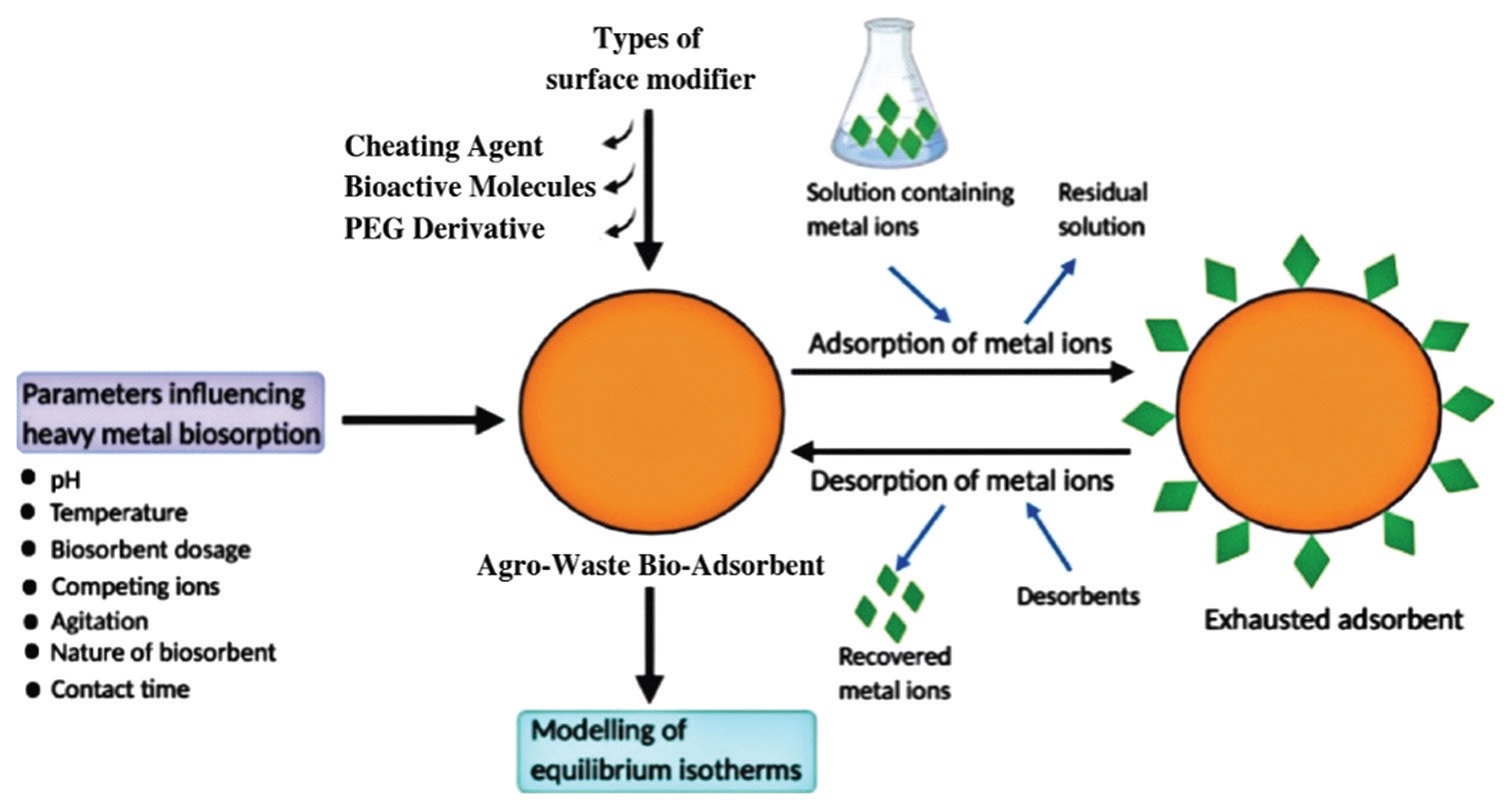
face adsorption, periphrasis through pores, and ion exchange. The present review presents different types of bio-adsorbents, their
uses, and their mechanism of action. Furthermore, these bio-adsorbents can be modified for better efficacy and reused repeatedly.
This review also includes several ways for improving the efficiency of bio-adsorbents and physicochemical conditions for
extracting heavy metals from waste streams.
Keywords
Bio-adsorbents Agricultural wastes Eradication Heavy metals Remediation.References
No references available for this article.
Citation
Astha Upadhyay*, Pooja Yadav, Shashi Maurya, S. N. Bharti. Sustainable Applications of Bio-adsorbents from Agricultural Wastes for Eradication of Heavy Metals from Aqueous Medium. Indian J. Adv. Chem. Sci. 2022; 9(4):416-421.