Removal of Acid Blue 25 Dye from Wastewater using Rambutan (Nephelium lappaceum Linn.) Seed as an Efficient Natural Biosorbent
Sivarama Krishna Lakkaboyana*, Soontarapa Khantong*, Mohammad Alamgir Kabir, Yuzir Ali, Wan Zuhairi Wan Yaacob
DOI: 10.22607/IJACS.2018.603003
Volume 6, Issue 3 | Pages: 111-117
Abstract
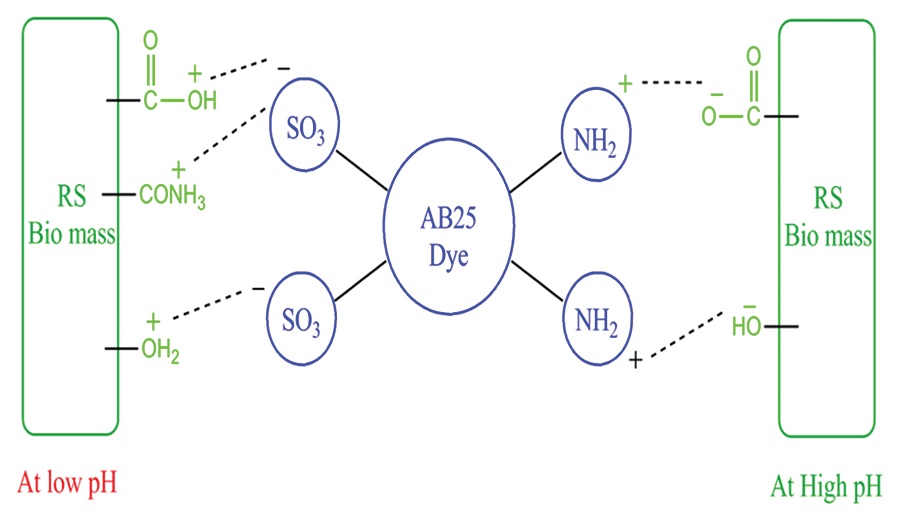
The potential of Rambutan seeds (RSs) for biosorption of acid blue 25 (AB25) from aqueous solutions was investigated in batch
systems in terms of kinetics and equilibrium. Experimental data showed that the biosorption capacity of RS was dependent
on operating variables such as solution pH, initial AB25 dye concentration, and contact time. The maximum biosorption has
occurred at pH 2 (87.06%). Significant enhancement of AB25 biosorption was observed by increasing initial dye concentration.
Adsorption kinetic data were fitted using the pseudo-first-order, pseudo-second-order (PSO), and intraparticle diffusion model.
The biosorption kinetics for the AB25 dye onto RS was best described by PSO kinetic model. Langmuir model exhibited the
best fit to experimental data. According to this adsorption isotherm model, the maximum AB25 biosorption capacity of RS is
35.58 mg/g. The low RL values (0.1357–0.0497) also confirmed that RS biomass is favorable for biosorption of AB25. The
results revel that adsorption is proceed with the chemisorption process. These results indicate that RS can be used as an effective
and environmentally friendly biosorbent to remove AB25 from wastewater.
Keywords
Rambutan seed Biosorption Kinetic Isotherms Acid blue 25 Wastewater.References
No references available for this article.
Citation
Sivarama Krishna Lakkaboyana*, Soontarapa Khantong*, Mohammad Alamgir Kabir, Yuzir Ali, Wan Zuhairi Wan Yaacob. Removal of Acid Blue 25 Dye from Wastewater using Rambutan (Nephelium lappaceum Linn.) Seed as an Efficient Natural Biosorbent . Indian J. Adv. Chem. Sci. 2018; 6(3):111-117.