Influence of Soil Stiffness on Seismic Vulnerability of Irregular Buildings
Mallangouda Biradar, S. K. Prasad
DOI: 10.22607/IJACS.2017.501007
Volume 5, Issue 1 | Pages: 50-53
Abstract
Seismic performance of building is a challenge to civil engineers, especially in India. The uncertainties of
earthquakes, complexity in construction, deviations from rules, and regulations during construction have made
many structures vulnerable during earthquakes. Complex soil conditions make the situation further worse. There
are many urban areas in seismically active zones with poor soil conditions having soft and thick overburden.
It has been well established that local site conditions can enhance the vulnerability of structures. This paper
attempts to show that irregular buildings that are generally vulnerable during earthquake will become even more
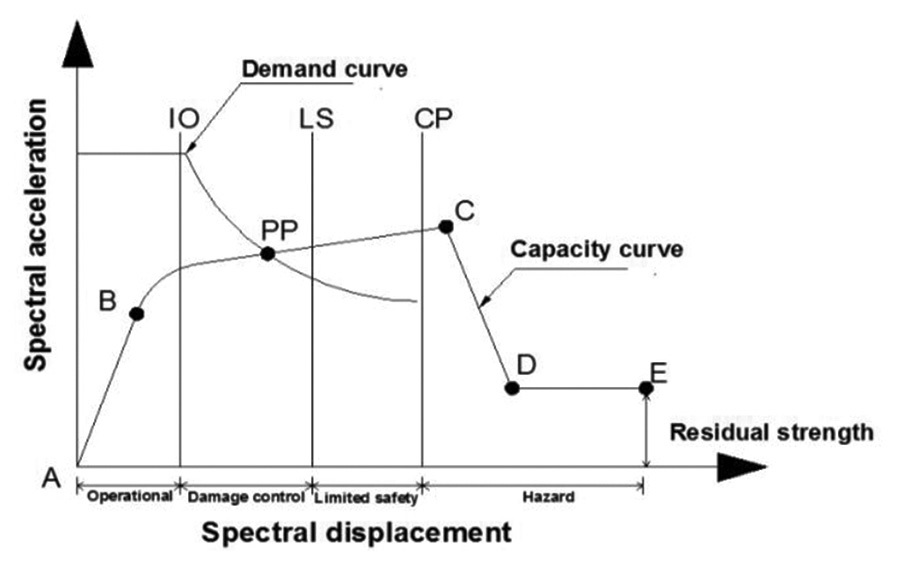
vulnerable due to poor soil conditions. For this purpose, ETABS, a finite element software that performs nonlinear
pushover analysis is used, and three dimensional analysis is performed. Two types of reinforced concrete frames,
one regular and symmetric in elevation and the other unsymmetric resting on three types of soil as per IS1893
(Part-1) 2002, namely hard soil, medium soil, and soft soil are considered in the analysis. Unsymmetric structural
frame on soft ground was found to be most vulnerable indicating that extra care is necessary when buildings are
built on soft soil in seismically active zones.
Keywords
Seismic vulnerability Pushover analysis Site effect Structure on soft ground ETABS.References
No references available for this article.
Citation
Mallangouda Biradar, S. K. Prasad. Influence of Soil Stiffness on Seismic Vulnerability of Irregular Buildings. Indian J. Adv. Chem. Sci. 2017; 5(1):50-53.