Levels of Some Trace Elements in Sera of Patients with Lung Cancer and in Smokers
Falah S. Al-Fartusie*, Alieàa Hafudh, Noor Mustafa, Hassanain Al-Bermani1, Ali Y. Majid
DOI: 10.22607/IJACS.2017.504017
Volume 5, Issue 4 | Pages: 344-352
Abstract
Lung cancer is one of the most common leading causes of cancer mortality around the world. Many efforts have
been made recently to use element contents in human body to aid for diagnosing various diseases including cancer.
Accordingly, this study aimed to investigate the serum contents of elements Cr, Cu, Mn, Ni, Zn, Mg, and Fe of lung
cancer patients and compared them with those found in smokers and non-smoking controls using atomic absorption
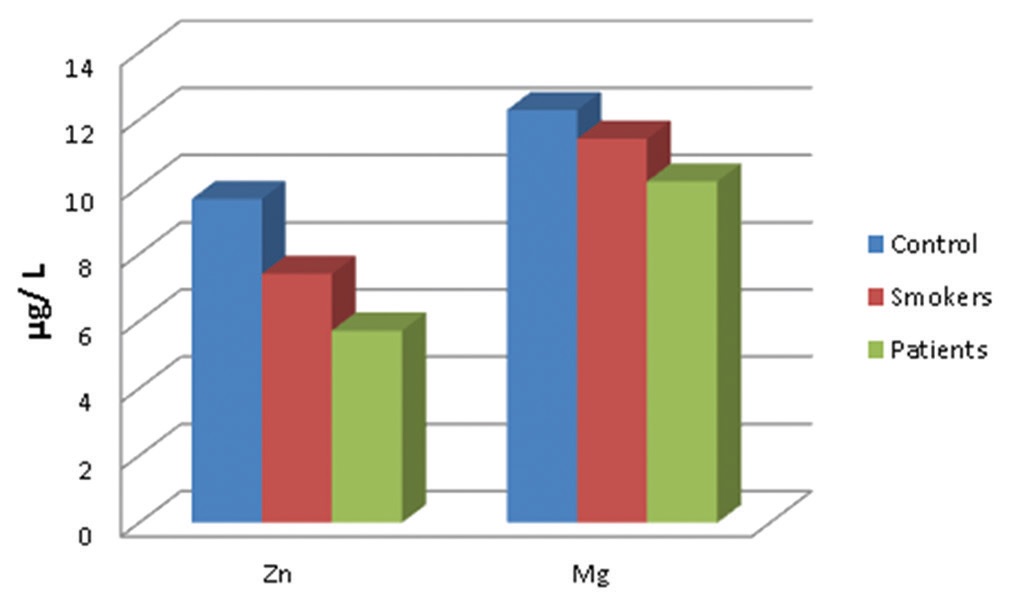
spectrophotometry technique. The results obtained showed that there were significantly lower levels of Zn, Fe, and
Mg (p<0.001) in patients and smokers than in non-smokers. The Zn and Mg levels of patients were significantly
lower than in smokers. The serum levels of Cu, Mn, Ni, and Cr were significantly higher (p<0.001) in lung cancer
patients than in smokers and controls. In addition, it was found out that the Cu/Zn ratio was significantly higher
in patients and smokers than those of controls. The results suggest that adequate intake of Zn and Mg may have a
protective role in the occurrence of lung cancer, while the high levels of Cu, Mn, Ni, and Cr may cause a threat of
lung cancer. It is also possible to conclude that exposure to cigarette smoke leads to impair oxidant defense system.
The data suggest that Cu/Zn ratio could be of great value in diagnosis and evaluating the lung cancer. In addition,
it is possible to rely on trace elements to give indications to warn, especially the smokers, of the risk of lung cancer.
Keywords
Lung cancer Trace elements Cu/Zn ratio Atomic absorption spectrometry Smoking.References
No references available for this article.
Citation
Falah S. Al-Fartusie*, Alieàa Hafudh, Noor Mustafa, Hassanain Al-Bermani1, Ali Y. Majid. Levels of Some Trace Elements in Sera of Patients with Lung Cancer and in Smokers. Indian J. Adv. Chem. Sci. 2018; 5(4):344-352.