Bimetallic Transition Metal Complexes of 2,3-Dihydroxy-N’1,N’4-bis((2‑Hydroxynaphthalen-1-yl)Methylene) Succinohydrazide Ligand as a New Class of Bioactive Compounds; Synthesis, Characterization and Cytotoxic Evaluation
Abdou S. El-Tabl*, Moshira M. Abd-El Wahed, Mohammed A. Wahba, Mohamad M. E. Shakdofa, Asia Gafer
DOI:
Volume 4, Issue 1 | Pages: 114-129
Abstract
New series of homobimetallic CuII, NiII, CoII, MnII, FeIII, ZnII, CdII, PbII complexes of 2,3-dihydroxy-N’1,N’4-bis((2-
hydroxynaphthalen-1-yl)methylene)succinohydrazide have been prepared and analytically and spectroscopically
characterized by elemental and thermal (differential thermal analysis and thermal gravim analysis) analyses,
infrared (IR), ultraviolet-visible spectra, magnetic moments,1H-nuclear magnetic resonance, mass spectra, molar
conductance, and electron spin resonance (ESR) measurements. The analytical and spectral data show that the
dihydrazone ligand behaves as a neutral, monobasic or dibasic hexadentate ligand bonded to the metal ions
through enolic or ketonic carbonyl oxygen atoms, azomethine nitrogen atoms and protonated or deprotonated
naphthanolic hydroxyl oxygen atoms adopted either tetrahedral, square planer or tetragonally distorted octahedral
geometries. Molar conductance in dimethylformamide solution indicates that the complexes are non-electrolytes.
The ESR spectra of solid CuII complexes (9-10) and 12 show axial type indicating a d(X2-y2) or d(Z2) ground state
with significant covalent bond character. However, MnII complex (2) and CuII complex (11) show isotropic type.
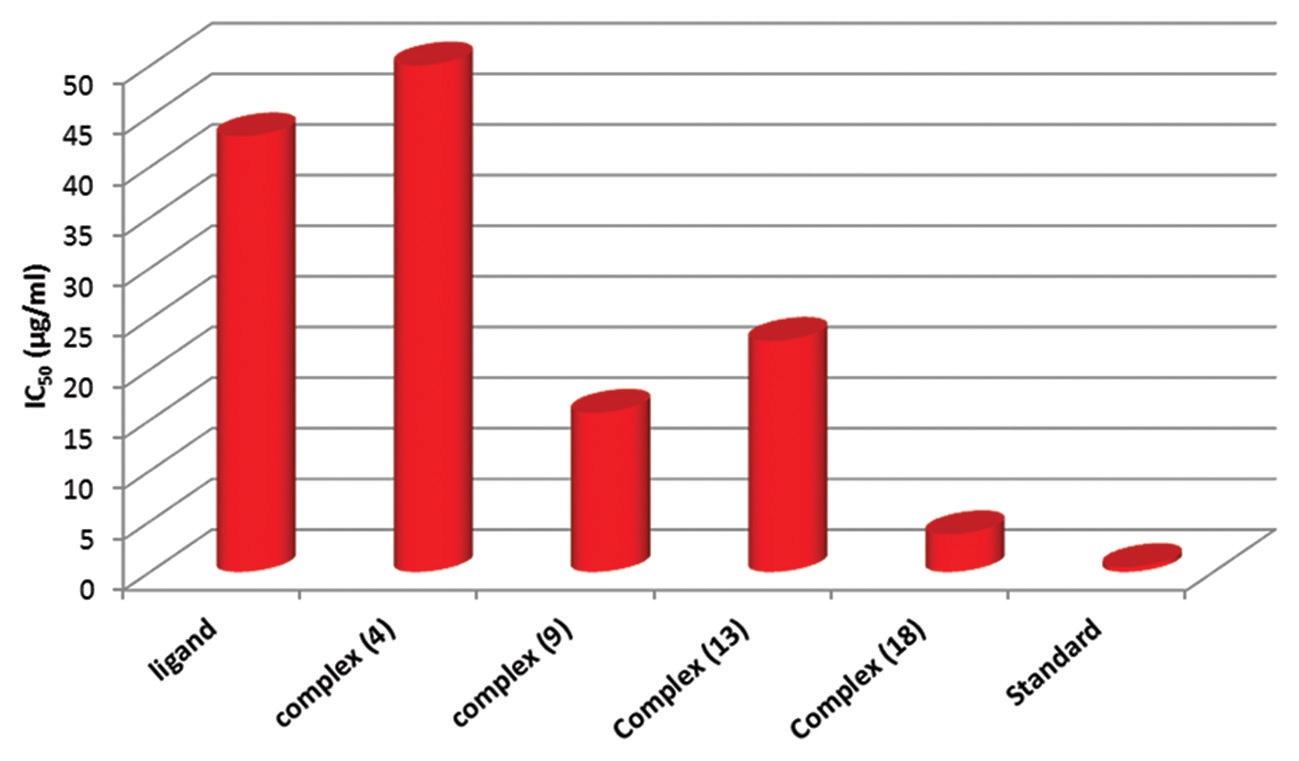
Cytotoxic evaluation of the ligand and its complexes has been carried out. Complexes show enhanced activity as
compared to the parent ligand.
Keywords
Hexadentate Succinohydrazide Dihydrazone Erythrocyte sedimentation rate Cytotoxic behavior.References
No references available for this article.
Citation
Abdou S. El-Tabl*, Moshira M. Abd-El Wahed, Mohammed A. Wahba, Mohamad M. E. Shakdofa, Asia Gafer. Bimetallic Transition Metal Complexes of 2,3-Dihydroxy-N’1,N’4-bis((2‑Hydroxynaphthalen-1-yl)Methylene) Succinohydrazide Ligand as a New Class of Bioactive Compounds; Synthesis, Characterization and Cytotoxic Evaluation. Indian J. Adv. Chem. Sci. 2016; 4(1):114-129.