Two Novel Azido, Thiocyanato bridged CoII/CuII complexes derived from Potential Azo-Schiff base blocker ligand (NN) of N,N’-Bis-(2-Amino-Ethyl)-Ethane-1,2-Diamine and 1-(5-chloro-2-hydroxy-phenyl)-Ethanone-Synthesis, characterization and magneto-structural correlations
Dhrubajyoti Majumdar
DOI:
Volume 4, Issue 3 | Pages: 327-335
Abstract
The potential azo-linked tetradentate Schiff base (H4L) blocker ligand was prepared from the 1:2 condensation of
triethylenetetramine with 5-chloro-2-hydroxyacetophenone. The tetradentate nitrogen donor ligand was allowed
to react with methanolic solutions of cobalt(II) nitrate hexahydrate and copper(II) nitrate trihydrate in the presence
of sodium azide and ammonium thiocyanate afforded mainly complex(1) [Co(H4L)(N3)]2(NO3)2 and complex(2)
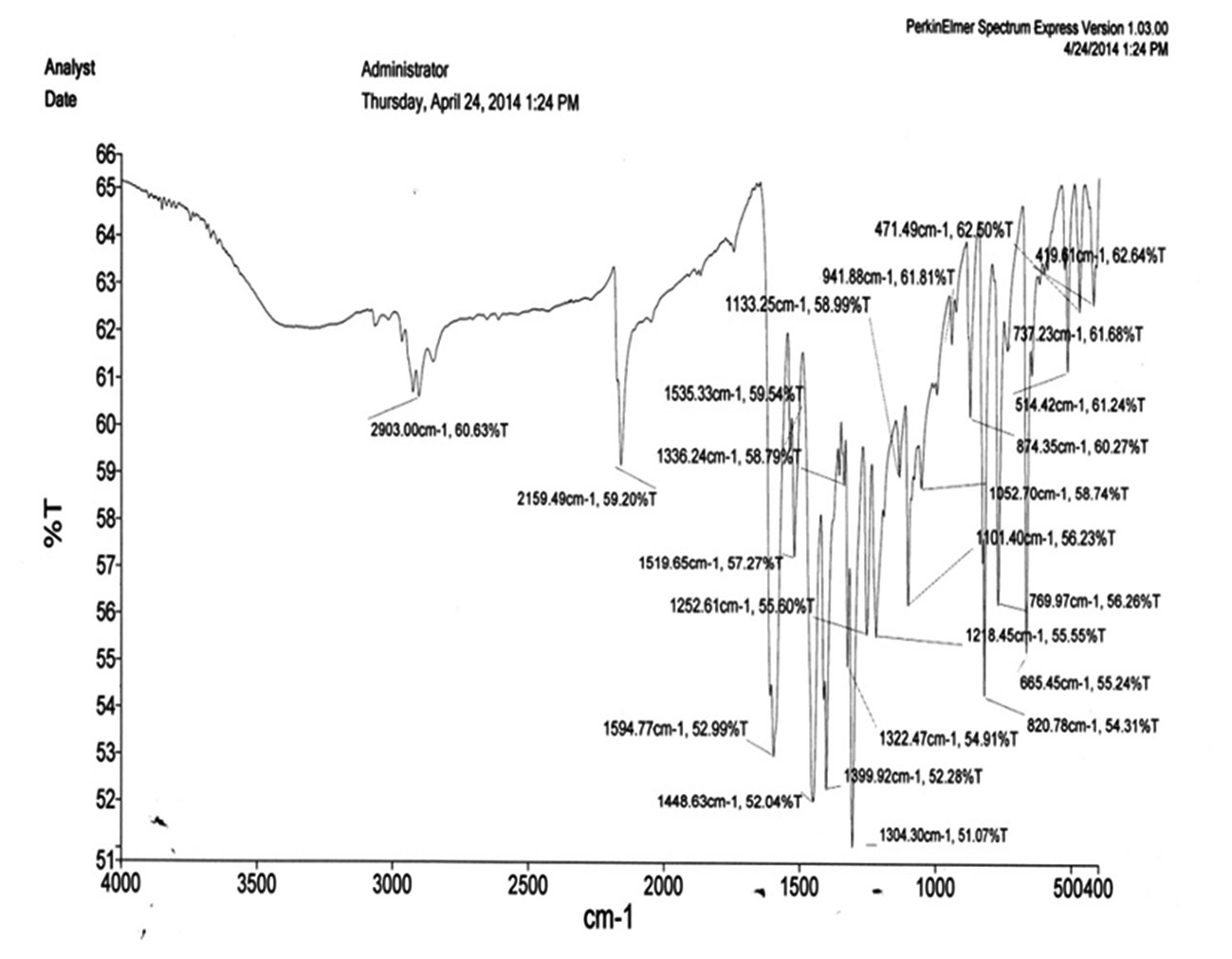
[Cu(H4L)(SCN)]NO3. Complex (1) and (2) were characterized by common elemental analysis(C, H and N), mass
(m/e), molar conductivity, infrared, 1nuclear magnetic resonance (H NMR), and ultraviolet-visible spectroscopy.
The potential compartmental Schiff base (H4L) ligand has been completely identified by 1H NMR spectroscopic
study. Molar conductivity studies confirmed that both complexes are electrolyte in nature. A brief magnetic
moment data will be provided to find out the expected probable geometry of complex (1) and complex (2). All the
experimental results unambiguously confirmed that in both complexes, Co(II) and Cu(II) bonded to the nitrogen
donor center only along with EO modes of azide bridging and common thiocyanate (S) terminal linkage, thus
fulfilling completely octahedral and square pyramidal geometry. Synthesized Co(II) and Cu(II) complexes also
showed magnetic moment value within the range 4.75-4.79 and 1.76 BM, respectively.
Keywords
Schiff base (H4L) SCN-1/N3-1 bridging Ultraviolet-visible Infrared 1H nuclear magnetic resonance spectra and Magnetic moment (μeff).References
No references available for this article.
Citation
Dhrubajyoti Majumdar. Two Novel Azido, Thiocyanato bridged CoII/CuII complexes derived from Potential Azo-Schiff base blocker ligand (NN) of N,N’-Bis-(2-Amino-Ethyl)-Ethane-1,2-Diamine and 1-(5-chloro-2-hydroxy-phenyl)-Ethanone-Synthesis, characterization and magneto-structural correlations. Indian J. Adv. Chem. Sci. 2016; 4(3):327-335.