DNA Binding/Cleavage Activity, Cytotoxic, and Density Functional Theory Studies of Pyridyl-Tetrazole Cu(II) Complexes
C. Amaravathi, Shaik Mustafa, M. S. Surendra Babu*
DOI:
Volume 4, Issue 4 | Pages: 394-400
Abstract
A new series of Cu(II) complexes were synthesized from isomeric pyridyl-tetrazole ligands such as 2-(1-vinyl-
1H-tetrazol-5-yl)pyridine (L1), 2-(2-vinyl-2H-tetrazol-5-yl)pyridine (L2), N,N-dimethyl-3-(5-(pyridin-2-yl)-
1H-tetrazol-1-yl)propan-1-amine(L3), and N,N-dimethyl-3-(5-(pyridin-2-yl)-2H-tetrazol-2-yl)propan-1-amine
(L4). All these complexes were characterized by the elemental analysis, molar conductance, Fourier transform
infrared, ultraviolet-visible (UV-VIS), magnetic moment, and electron spin resonance studies. The conductance
and spectroscopic data suggested that the ligands act as monobasic bidentate ligands and form square planar
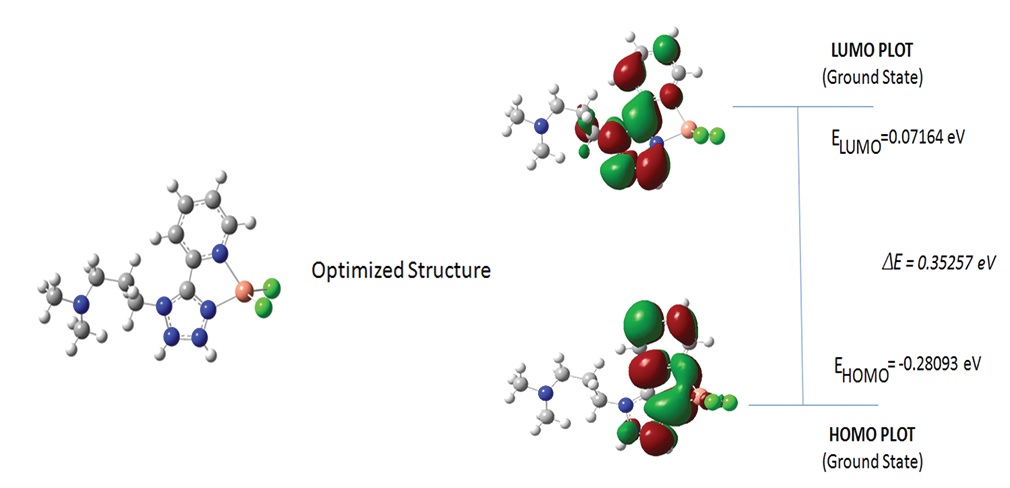
complexes with general formula [Cu(L)Cl2]. Highest occupied molecular orbital and lowest unoccupied molecular
orbital studies of complexes were carried by density functional theory calculation using B3LYP method. Binding
studies were carried by UV-VIS absorption revealed that each of these complexes is avid binders of calf thymus
DNA. The nucleolytic cleavage activities of complexes were carried on double-stranded pBR322 circular plasmid
DNA using a gel electrophoresis experiment under various conditions, where cleavage of DNA takes place by
oxidative free radical mechanism (•OH). Further modification of complex structure can further improve the
cleavage activity in nano concentration to decrease the side effects.
Keywords
Pyridyl-tetrazole Pendant arm Copper complexes DNA binding.References
No references available for this article.
Citation
C. Amaravathi, Shaik Mustafa, M. S. Surendra Babu*. DNA Binding/Cleavage Activity, Cytotoxic, and Density Functional Theory Studies of Pyridyl-Tetrazole Cu(II) Complexes. Indian J. Adv. Chem. Sci. 2017; 4(4):394-400.