Performance of Uranous nitrate and Acetohydroxamic Acid on the Partitioning of Plutonium and Uranium in Compact Reprocessing of Advanced Fuels in Lead Cells Reprocessing Facility
S. Sukumar, R. Srinivasan
DOI:
Volume 3, Issue 3 | Pages: 282-287
Abstract
A case study on the performance of uranous nitrate and acetohydroxamic acid on the partitioning of plutonium
and uranium was studied. The loaded organics (30% tri-butyl phosphate in normal paraffi n hydrocarbon as
diluent) contains plutonium, uranium, and fi ssion products such as Cs and Ru. Aqueous feeds containing 7 g/L
uranous nitrate with 0.5 M hydrazine nitrate in 1 M nitric acid, and 0.3 M acetohydroxamic acid (AHA) in
1.5 M nitric acid were used as partitioning agents. Volume ratio of organic to aqueous was maintained as a
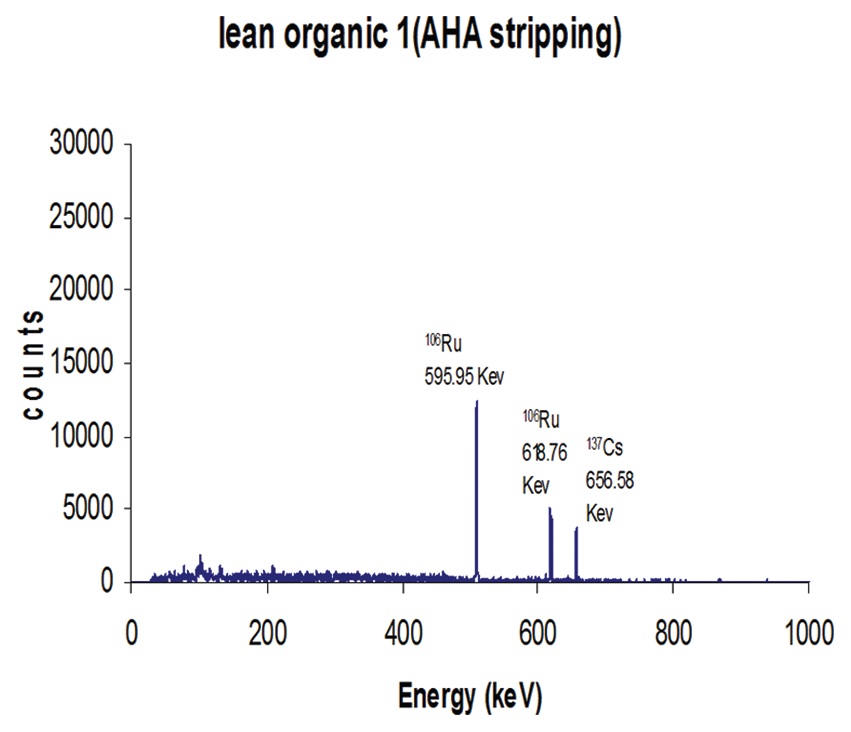
unity. Gamma spectrum was taken from the lean organic and strip product to study the behavior of Ru and Cs
distribution during partitioning. Uranous was found to be more effective in stripping plutonium, but it always
contains the quantitative amount of uranium in the strip product. AHA, on the other hand, required more number
of stages for effective partitioning but provides plutonium with the allowable amount of uranium in the strip
product. Uranous was more effective in the decontamination of Cs, whereas both uranous and AHA were less
effective in the decontamination of Ru.
Keywords
Nuclear fuel reprocessing Acetohydroxamic acid Uranous nitrate Ruthenium and cesium.References
No references available for this article.
Citation
S. Sukumar, R. Srinivasan. Performance of Uranous nitrate and Acetohydroxamic Acid on the Partitioning of Plutonium and Uranium in Compact Reprocessing of Advanced Fuels in Lead Cells Reprocessing Facility. Indian J. Adv. Chem. Sci. 2015; 3(3):282-287.