Physicochemical Properties and its Relationship with Water Holding Capacity of Roadside Tea Cultivated Soils in Dibrugarh District of Assam, India
T. N. Nath
DOI:
Volume 3, Issue 3 | Pages: 288-292
Abstract
A study was carried out to assess the physical and chemical properties of soils and its relationship with water
holding capacity (WHC) of roadside tea cultivated soils close to national highway 37 (NH 37) in the Dibrugarh
district of Assam. 60 soil samples were collected from both sides of the NH at the distances of 100 m, 200 m,
and 300 m, respectively. The result of the analysis showed that as the roadside distance increases from the road
edge the physicochemical parameters of the soil decreases slightly in a constant pattern. The texture of the soil
samples found to be sandy clay loam. The sand, silt, and clay content of soil samples varied within the ranges of
72.80±6.71-73.27±6.56, 5.02±0.37-5.18±0.48, and 21.56±6.08-22.18±6.34%, respectively. The soil pH ranged
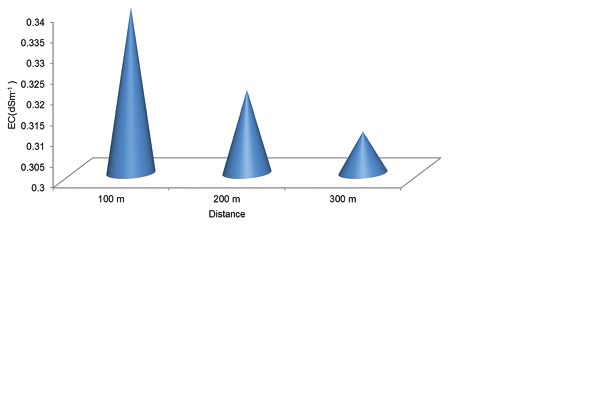
5.20±0.08-5.36 ±0.18 and soil electrical conductivity ranged 0.31±0.07-0.34±0.08 dSm−1 . The total organic
matter content and WHC varied from 2.64±0.72 to 3.05±0.81% and 60.72±5.26 to 63.08±5.46%, respectively.
It was concluded that soil texture mainly clay fraction and total organic matter content had infl uenced on WHC
of roadside tea cultivated soil. It was suggested that the high content of clay fraction and organic matter on
soil should be incorporated to the soils with improving WHC. A signifi cance positive relationship was observed
between WHC with clay and organic matter content, while, a negative relationship was found with sand content.
Keywords
Soil texture Total organic matter content Water holding capacity.References
No references available for this article.
Citation
T. N. Nath . Physicochemical Properties and its Relationship with Water Holding Capacity of Roadside Tea Cultivated Soils in Dibrugarh District of Assam, India. Indian J. Adv. Chem. Sci. 2015; 3(3):288-292.