Groundwater Geochemistry Study of Estuarine Aquifer, Western India: Mumbai using Chemometric and Conventional Techniques
Sabyasachi Rout, Ajay Kumar, P.K. Sarkar, Manish K. Mishra, P.M. Ravi
DOI:
Volume 1, Issue 1 | Pages: 1-9
Abstract
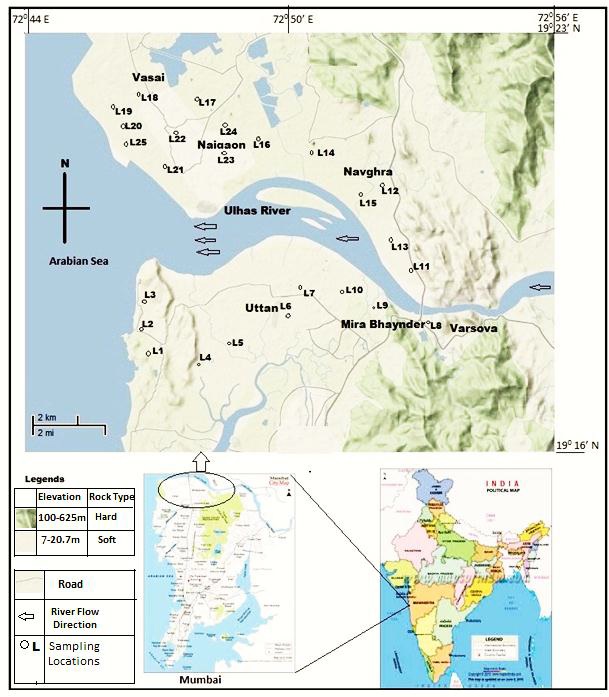
A hydrogeochemical study of an estuarine aquifer system was carried out to find significant processes
controlling groundwater geochemistry. The data interpretation was carried out using both conventional as well
as chemometric techniques. Piper’s Trilinear diagram identified (Na+K)–(SO4+Cl), (Ca+Mg)–(SO4+Cl) and
(Ca+Mg)–HCO3 as predominating hydrochemical facies of the area. Both Gibbs classical diagrams and
stability diagrams revealed that rock weathering as the important geochemical process controlling the
groundwater chemistry rather than atmospheric precipitation although the study site is under high rainfall.
Stability diagram and hydrochemical indices study ruled out the seawater intrusion to the aquifer. Kaolinite was
found to be predominating clay mineral of the site. Chemometric analysis like Factor analysis of hydrochemical
data, extracts three hydro-chemically meaningful factors which includes both natural and anthropogenic origin.
Keywords
Ulhas Estuary Saline intrusion Kaolinite Hydrogeochemistry Factor Analysis Piper Trilinear Plot Stability Diagram.References
No references available for this article.
Citation
Sabyasachi Rout, Ajay Kumar, P.K. Sarkar, Manish K. Mishra, P.M. Ravi. Groundwater Geochemistry Study of Estuarine Aquifer, Western India: Mumbai using Chemometric and Conventional Techniques. Indian J. Adv. Chem. Sci. 2013; 1(1):1-9.