Indoor PM2.5 and Microbial Contaminants in Developing Countries: Sources, Chemical Interactions, Exposure Pathways, and Health Outcomes
Anam Taushiba, Rahila Rahman Khan, Alfred Lawrence
DOI: DOI: 10.22607/IJACS.2025.1401001
Volume 14, Issue 1 | Pages: 1-13
Abstract
Indoor air pollution has emerged as a critical but under-recognized health burden, particularly in developing countries where
households are frequently exposed to unsafe concentrations of fine particulate matter (PM2.5) and microbial contaminants.
Vulnerable populations, especially women, children, and the elderly, spend most of their time indoors, yet remain unprotected by
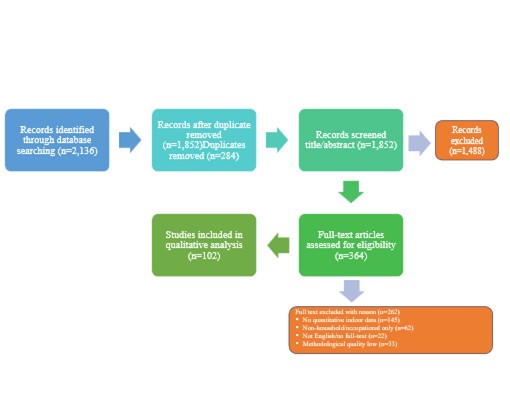
enforceable standards. This review, conducted under the Preferred Reporting Items for Systematic Reviews and Meta Analyses
2020 framework, systematically examined 102 studies published between 2000 and 2025, synthesizing evidence on pollutant
chemistry, microbial ecology, exposure pathways, and health outcomes across residential, industrial-adjacent, and commercial
households. Findings reveal that indoor PM2.5 in developing countries is enriched with organic carbon, polycyclic aromatic
hydrocarbons, transition metals, and secondary aerosols, often exceeding the World Health Organization guidelines by 5–10
folds. Microbial contaminants, including fungi, Gram-negative bacteria, endotoxins, and β-glucans, commonly surpass reference
levels set in developed countries, with synergistic PM2.5 microbe complexes amplifying oxidative stress, inflammation, and
systemic toxicity. Comparative analysis demonstrates stark inequalities, while developed nations enforce indoor air quality
standards and adopt advanced monitoring tools (e.g., condensation particle counters, scanning mobility particle sizers, and
quantitative polymerase chain reaction), developing countries rely on gravimetric and culture-based approaches, resulting in
chronic underestimation of risks. This review emphasizes the urgent need for indoor-specific air quality guidelines, integrated
chemical and biological monitoring frameworks, and affordable mitigation technologies tailored for resource-limited settings.
Addressing these gaps would not only safeguard health but also reduce economic losses associated with productivity decline
and healthcare burden. By reframing indoor pollution as a dual chemical-microbial hazard, this review calls for decisive global
and national action to protect vulnerable dwellers and to bridge the inequities in environmental health between developed and
developing regions.
Keywords
Indoor air pollution Microbial contaminants Particulate matter Women’s healthReferences
No references available for this article.
Citation
Anam Taushiba, Rahila Rahman Khan, Alfred Lawrence. Indoor PM2.5 and Microbial Contaminants in Developing Countries: Sources, Chemical Interactions, Exposure Pathways, and Health Outcomes. Indian J. Adv. Chem. Sci. 2026; 14(1):1-13.