Comparative Evaluation of Additive Manufacturing Processes
Mukund Joshi, Nagaraja Shetty, N. L. S. Bharath, Chanakya Varma Surapaneni
DOI:
Volume , Issue 2 | Pages: 22-26
Abstract
Rapid prototyping (RP) is an additive manufacturing process used for creating objects that are inconvenient or
expensive to manufacture by conventional machining processes. Considering its growing popularity in today’s
world, it becomes necessary to quantify this technology to give its users a clear picture about how beneficial RP
could be if it were made commonly available at cheaper rates. One of the most useful manufacturing technologies
existing today, RP helps in the creation of miniature prototypes of large machines and structures, medical
equipment, and even art forms. There are several different forms of this technology which employs different
methods and different materials to print three-dimensional solid objects. This creates a dilemma to the user,
as he has to make a choice between these forms of RP to use it for his needs. This paper emphasizes on the
qualitative testing of identical specimens created by two of the most popular RP processes available today,
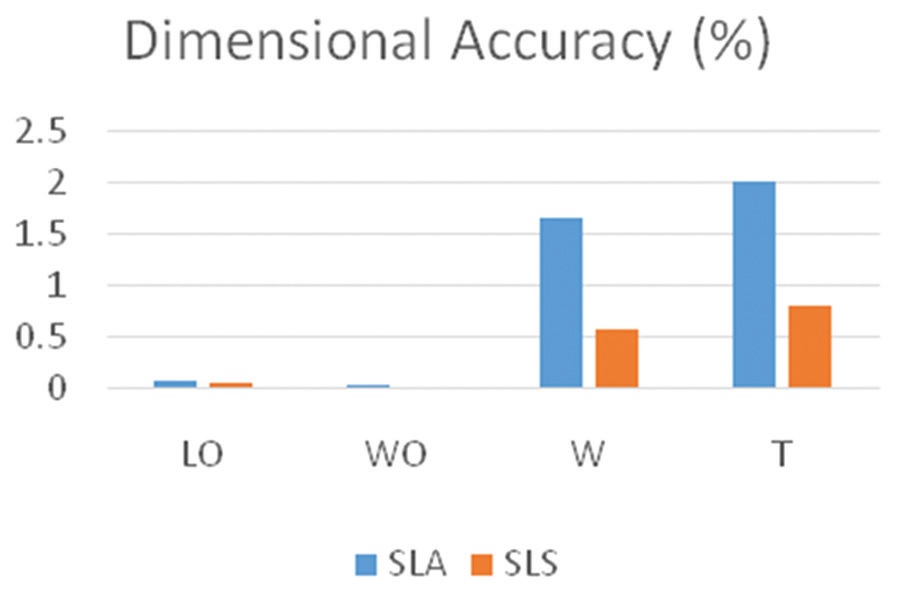
namely, stereolithography apparatus (SLA) and selective laser sintering (SLS). The specimens will be evaluated
on the parameters of dimensional accuracy, tensile strength, water absorption, shore hardness, surface roughness,
density, and microscopic defect structure. The outcome of this study aims at helping people to understand SLS and
SLA better in terms of the products they create so that it becomes easier for users to make a choice between the
two. It also aims at highlighting the above-mentioned statistical information about SLA and SLS so that they may
be improvised and enhanced in the future.
Keywords
Stereolithography Selective laser sintering Rapid prototyping Additive manufacturing Mechanical properties.References
No references available for this article.
Citation
Mukund Joshi, Nagaraja Shetty, N. L. S. Bharath, Chanakya Varma Surapaneni. Comparative Evaluation of Additive Manufacturing Processes. Indian J. Adv. Chem. Sci. -0001; (2):22-26.