Synthesis, Characterization, Antimicrobial Activity, and Optical Properties of Schiff Bases Derived from 4-(Aminomethyl) Piperidine
C. S. Karthik, L. Mallesha, M. Veeranna Santhosh, S. Nagashree, P. Mallu
DOI:
Volume , Issue 2 | Pages: 206-212
Abstract
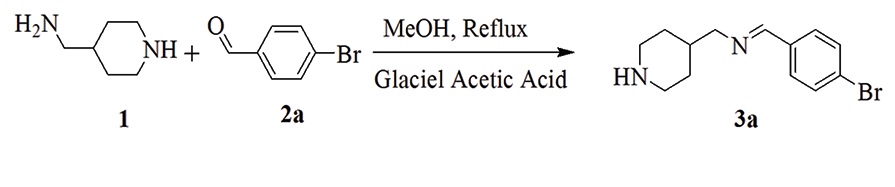
The present work was conducted to study the photophysical properties of Schiff bases derived from 4-(aminomethyl)
piperidine 3(a-b) and was synthesized by the reaction of 4-aminomethyl piperidine (1) with various aldehydes
2(a-b). Newly synthesized compounds were characterized by ultraviolet-visible-near-infrared (UV-vis-NIR),
Fourier transform infrared, and 1H nuclear magnetic resonance spectral studies. Optical parameters, such
as extinction coefficient, refractive index, real and imaginary parts of dielectric constant, loss factor, optical
conductivity, and electrical conductivity, were studied using the absorbance spectra UV-vis-NIR spectrophotometer
in the spectral range 200-1100 nm. UV-vis-NIR spectral studies predicted low absorbance by the compound in the
entire visible range. The compound exhibited optical band gap (Eg) around 3.24 eV and 3.07 eV for 3a and 3b,
respectively. The Urbach energy, optical conductivity, and electrical conductivity were also estimated from other
optical parameters. These properties of the compound can be exploited for its application in optoelectronics.
These new compounds were evaluated for their in-vitro antimicrobial effect using the agar-well diffusion method
against three Gram-positive bacteria, three Gram-negative bacteria, and three fungi. The synthesized compounds
exhibited significant biological activity against the tested microorganisms.
Keywords
Antimicrobial property Dielectric properties Optical properties Optical conductivity and electrical conductivity.References
No references available for this article.
Citation
C. S. Karthik, L. Mallesha, M. Veeranna Santhosh, S. Nagashree, P. Mallu. Synthesis, Characterization, Antimicrobial Activity, and Optical Properties of Schiff Bases Derived from 4-(Aminomethyl) Piperidine. Indian J. Adv. Chem. Sci. -0001; (2):206-212.