Enzyme Immobilization Methods and Role of Conductive Polymers in Fabrication of Enzymatic Biosensors
N. Kumara Swamy*, S. Sandeep, A. S. Santhosh
DOI: 10.22607/IJACS.2017.S02001
Volume , Issue 3 | Pages: 1-5
Abstract
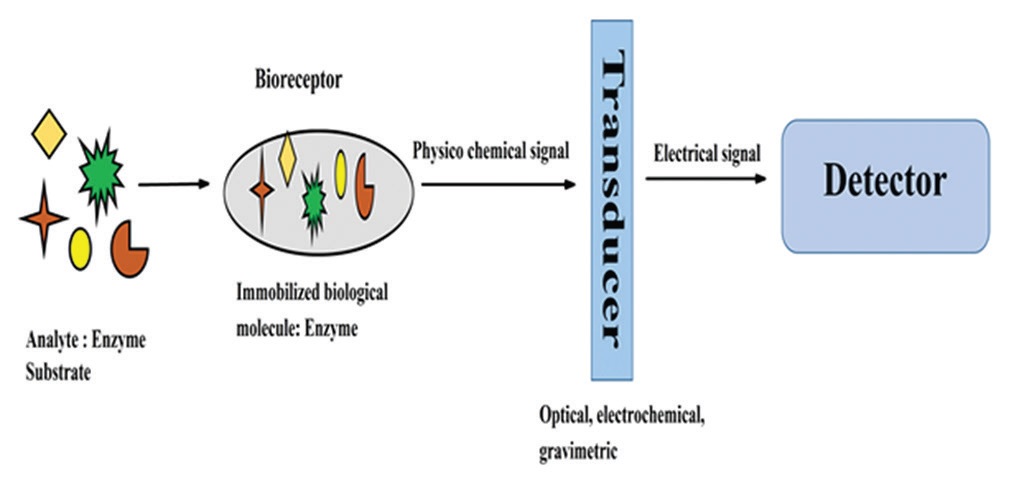
Immobilization of enzymes on the transducer surface is a necessary and critical step in the design of biosensors.
The conducting polymers play a very significant role in the development of enzymatic sensors having emerged
as effective transducer materials. This paper briefly discusses various enzyme immobilization methods based
on physical adsorption, covalent linking, entrapment, cross-linking, and also the role of conducting polymers
as immobilization platforms in the fabrication of enzymatic biosensors. The study concluded that the choice of
immobilization method and the conducting polymer greatly influence the enzyme orientation, loading, mobility,
stability, structure, and biological activity which in turn affects the performance of biosensor in terms of sensitivity,
selectivity, and stability.
Keywords
Conducting polymers Enzyme immobilization Enzymatic sensors.References
No references available for this article.
Citation
N. Kumara Swamy*, S. Sandeep, A. S. Santhosh. Enzyme Immobilization Methods and Role of Conductive Polymers in Fabrication of Enzymatic Biosensors . Indian J. Adv. Chem. Sci. -0001; (3):1-5.