Artificial Intelligence-Driven Drug Discovery: A Preferred Reporting Items for Systematic Reviews and Meta-Analyses-Guided Systematic Review of Recent Advances in Computational Chemistry and Bioinformatics
Pigili Akhil Kumar, Bhavya Krishnan, Ayyappa Mandla, N Srikanth Reddy
DOI: DOI: 10.22607/IJACS.2026.1403002
Volume 14, Issue 3 | Pages: 92-106
Abstract
Background: The integration of artificial intelligence (AI) into drug discovery has accelerated dramatically between 2020
and 2025, with breakthrough developments in deep learning, generative AI, and foundation models transforming traditional
pharmaceutical research workflows. Objective: This systematic review synthesizes recent advances in AI-driven drug discovery,
with a focus on computational chemistry and bioinformatics integration, following Preferred Reporting Items for Systematic
Reviews and Meta-Analyses (PRISMA) 2020 guidelines. Methods: A comprehensive literature search was conducted across
PubMed, Scopus, Web of Science, Google Scholar, IEEE Xplore, and ScienceDirect databases. Studies published between
January 2020 and December 2025 involving AI applications in drug discovery were included. Data were extracted on AI
methodologies, datasets, drug discovery stages, and major outcomes. Results: From 5,529 initial records, 56 studies were
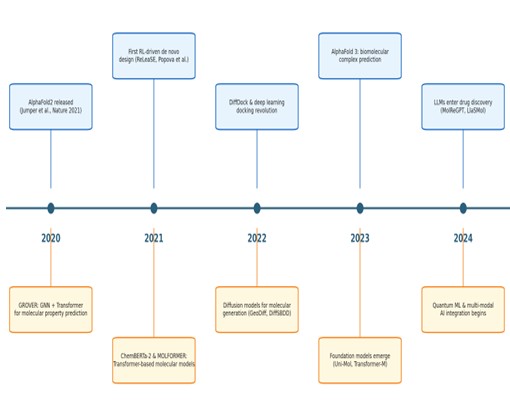
included in qualitative synthesis. Key findings reveal that (1) graph neural networks and transformer architectures have become
dominant approaches for molecular representation learning; (2) AlphaFold and its successors have revolutionized structure-based
drug design; (3) diffusion models and reinforcement learning are driving de novo molecular design; (4) large language models
are emerging as powerful tools across the drug discovery pipeline. Integration of AI with molecular dynamics, QSAR modeling,
and network pharmacology has demonstrated significant potential for accelerating target identification, hit discovery, lead
optimization, and absorption, distribution, metabolism, excretion, and toxicity prediction. Conclusion: AI-driven drug discovery
has matured considerably during 2020–2025, with multi-modal foundation models and autonomous AI platforms representing
the next frontier. However, challenges remain in model interpretability, experimental validation, data quality, and regulatory
frameworks. Standardized benchmarks and interdisciplinary collaboration will be essential for translating computational
advances into clinical therapeutics. This review highlights the transformative role of AI in accelerating drug discovery by
integrating computational chemistry, bioinformatics, and machine learning approaches. By systematically evaluating recent
advances through a PRISMA-guided framework, the study provides researchers with a comprehensive overview of emerging
methodologies, current challenges, and future opportunities for AI-enabled pharmaceutical innovation.
Keywords
AlphaFold Artificial intelligence Computational chemistry Deep learning Drug discovery Graph neural networks Molecular design.References
No references available for this article.
Citation
Pigili Akhil Kumar, Bhavya Krishnan, Ayyappa Mandla, N Srikanth Reddy. Artificial Intelligence-Driven Drug Discovery: A Preferred Reporting Items for Systematic Reviews and Meta-Analyses-Guided Systematic Review of Recent Advances in Computational Chemistry and Bioinformatics. Indian J. Adv. Chem. Sci. 2026; 14(3):92-106.