Impact of Insecticides and Fungicides on Bacterial Population in Groundnut (Arachis hypogaea. L.) Soils
P. Ramanamma, M. Srinivasulu, K. Swetha, V. Rangaswamy
DOI: 10.22607/IJACS.2023.1101006
Volume 11, Issue 1 | Pages: 38-42
Abstract
A field experiment was conducted at Sri Krishnadevaraya University, Anantapuramu, India to study the population of bacteria in
groundnut soil. Most important annual oil seed crop is the groundnut. The yield of crop depends on various agronomic management
practices. The groundnut bacterial composition in the rhizosphere is important for the performance of plant as bacterial species can
have beneficial, neutral, or harmful relationships with the roots. Bacteria are important in process such as nitrification, denitrification,
and nitrogen fixation. Soil bacteria play an important role in the global cycling of carbon and other elements. Soils containing a high
microbial diversity are characteristic of a healthy soil-plant relationship. Soil samples (red sandy loam and black clay soils) were
collected from groundnut (Arachis hypogaea L.) cultivated fields of Anantapuramu District of Andhra Pradesh, were treated with
selected insecticides – bifenthrin, buprofezin and fungicides-dimethomorph, pyraclostrobin at different concentrations, that is, 10, 25,
50, 75, and 100 ppm which are equivalent to field application rates (1.0, 2.5, 5.0, 7.5, and 10.0kg/ha) in the laboratory. Results of the
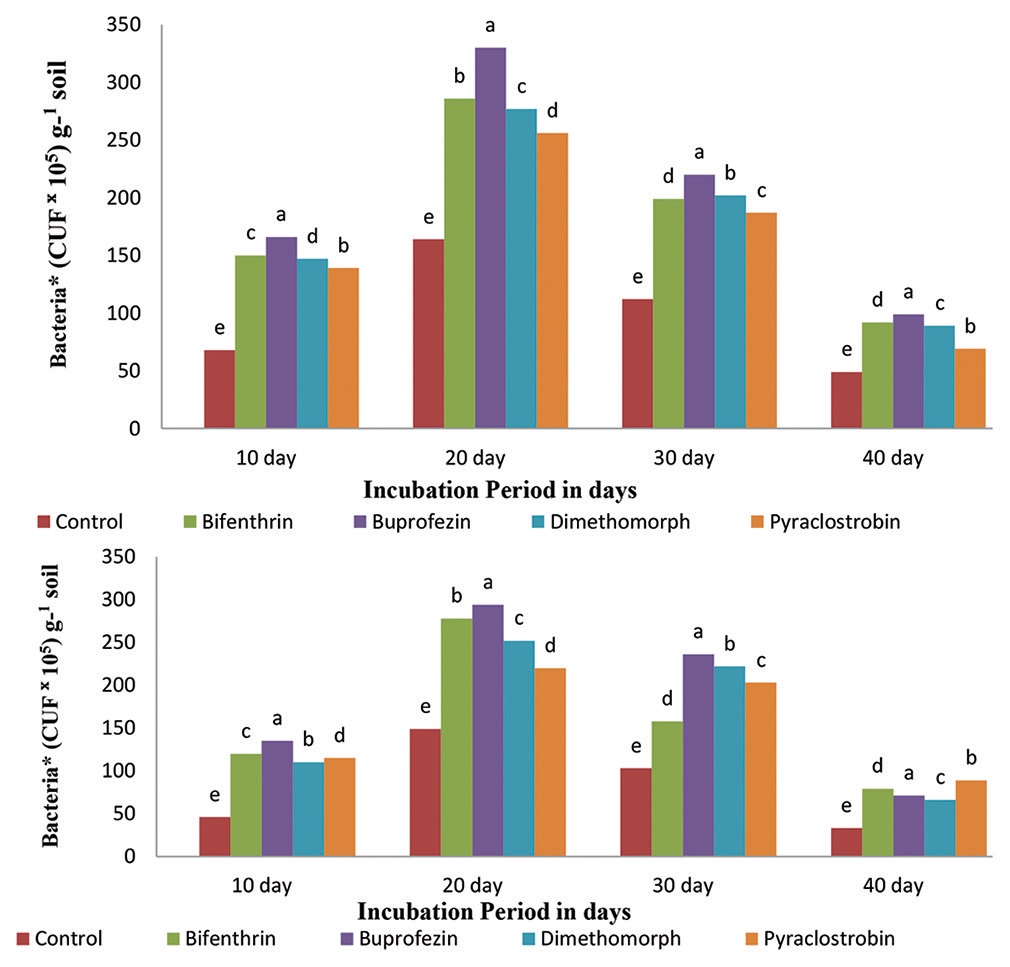
study showed that the bifenthrin, buprofezin, dimethomorph, and pyraclostrobin significantly improved the bacterial population in
10 days incubated both red and black soil samples. Bifenthrin and buprofezin at concentrations ranging from 1.0 to 5.0kg/ha gradually
increased the population of bacteria and reached maximum at 5.0 kg/ha. Beyond 5.0 kg/ha the above pesticides shown negative effect
on bacterial population at 10.0 kg/ha, whereas the bacterial population had decreased at concentration of 7.5–10.0 kg/ha. Whereas
dimethomorph and pyraclostrobin at the concentrations of 1.0 and 2.5 kg/ha showed marked increase in bacterial populations, and
beyond this concentration the bacterial population reached minimum at 10.0 kg/ha in both black and red soils
Keywords
Bacteria Insecticides Fungicides Groundnut (Arachis hypogaea L.) Soils.References
No references available for this article.
Citation
P. Ramanamma, M. Srinivasulu, K. Swetha, V. Rangaswamy. Impact of Insecticides and Fungicides on Bacterial Population in Groundnut (Arachis hypogaea. L.) Soils. Indian J. Adv. Chem. Sci. 2023; 11(1):38-42.