Design, Synthesis, and Spectroscopic Investigation of Cobalt(II) and Ni(II) Complexes of Schiff Bases Incorporating Bicyclic Heterocycles and Pyridine-Linked Aminothiol Moieties
Asif Reza, Ashok Kumar Yadav
DOI: DOI: 10.22607/IJACS.2026.1403004
Volume 14, Issue 3 | Pages: 120-126
Abstract
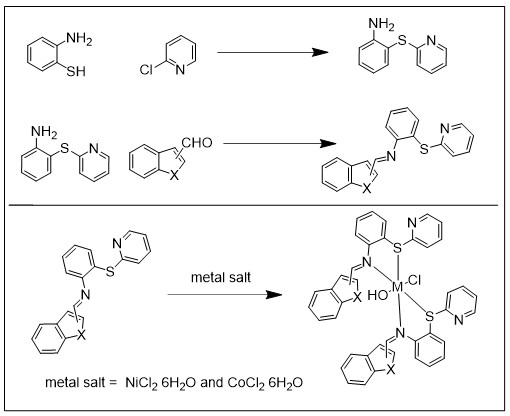
A series of new Schiff base ligands incorporating bicyclic heterocycles and a pyridine-linked aminothiol framework were
designed and synthesized, followed by preparation of their cobalt(II) and nickel(II) complexes. The ligands were obtained
through condensation of 2-(pyridin-2-ylthio)aniline with indole-3-, benzothiophene-3-, and benzofuran-based aldehydes,
providing N,S-donor systems capable of effective metal coordination. Complexation reactions with cobalt(II) and nickel(II)
salts afforded stable, colored compounds in moderate yields. The synthesized ligands and complexes were characterized by
elemental analysis, Fourier transform infrared, NMR spectroscopy, and magnetic susceptibility measurements. Spectral data
indicated coordination through the azomethine nitrogen and thioether sulfur atoms, forming chelate structures around the metal
centers. Magnetic studies suggested octahedral geometry for both cobalt(II) and nickel(II) complexes. The study demonstrates
how incorporation of bicyclic heteroaromatic units and mixed donor sites can influence coordination behavior and stability,
providing structurally diverse metal complexes with potential relevance for catalytic and biological applications.
Keywords
Cobalt Metal complexes Pyridine heterocycle Schiff’s baseReferences
No references available for this article.
Citation
Asif Reza, Ashok Kumar Yadav. Design, Synthesis, and Spectroscopic Investigation of Cobalt(II) and Ni(II) Complexes of Schiff Bases Incorporating Bicyclic Heterocycles and Pyridine-Linked Aminothiol Moieties. Indian J. Adv. Chem. Sci. 2026; 14(3):120-126.